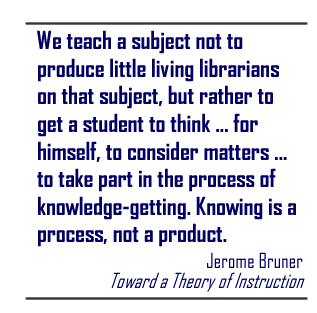
This philosophy of education was written less than a year ago, and as I reread it to see if any revisions
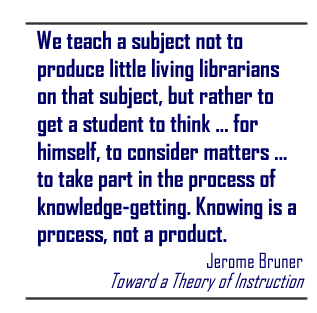
were needed I was surprised to find that if anything my convictions had deepened. I firmly aspire to the implementation of a constructivist learning environment. Many of my classes use a hands on approach where students actively participate in constructing knowledge. We work together, relying on prior knowledge, and employing discussions to sort out the details that are necessary for success. I also often offer time for students to reflect in writing on their thoughts, experiences, and new knowledge. The result is a lively classroom, where students engage in conversations that would make any teacher proud. This approach also helps me build lasting relationships with my students, and my abilities as a teacher grow because I learn about each student and the gifts they can bring into the shared learning environment which is inherently a social space.
Philosophy of Education
The contemporary classroom is an intense landscape of diversity each participant brings a wealth of prior knowledge, experience, and skills, as well as a unique world understanding. As educators we are tasked to teach and skills, and inspire students to invest in their education, and ultimately their own potential. Vygotsky’s social development theory posits awareness, perception, reasoning, and judgment develop as a result of social interaction (Burkitt, 2006). It seems logical then that education should consist of a social interaction embedded into learning experiences that engage students.
In order for students to achieve the maximum benefit from a learning experience they should engage in active construction of knowledge and reflect meaningfully on the implications of the gained knowledge. Social activities with structured objectives can engage students in critical discussion with their peers, when provided appropriate guidance. These discussions and other collaborative activities are most successful when students can make connections between existing knowledge and experiences, and new knowledge and experiences. In this type of learning environment the teacher is an architect of instructional experiences, with knowledge in the art and science of teaching with their students in mind. Teachers must be effective if not extraordinary strategists, working with a toolkit of resources, inquiries, exploratory, and discovery learning activities, and working with a diverse set of learners each with a range of emotional, social, educational, and environmental needs.
Increasingly there is demand and incentive to incorporate technology into classroom practices. The basic levels of technology vary from district to district, and even between campuses. If employed appropriately, teachers can adopt technology enhanced instructional content, and expand students’ breadth of 21st century knowledge and skills. When resources permit, students should be given opportunities to collaborate in the shared social construction of knowledge while simultaneously advancing technology knowledge and skills
Theoretical Framework
This set of educational philosophies is best aligned with a constructivist epistemology. Constructivism as an educational paradigm rests on the ontological notion that knowledge, and particularly meaning, is socially constructed. From this perspective, knowledge is gained through meaningful and authentic interactions within a shared social space. Students engage in peer teaching, and collaborative learning exercises, and the teacher facilitates student interactions by asking questions, providing direction and guidance, and direct teaching when necessary. Problem based learning (PBL) and discovery learning are hallmark instructional strategies of the constructivist learning environment (Herie, 2005).
Authentic learning happens when the learners make meaningful connections to information, drawing on prior knowledge and pre-constructed categories and themes already learned, and consequently internalize that information, adding to the puzzle of their own understanding of the world (Splitter, 2009). Authenticity then is instructional content that not only connects to the “real” world, but also engages learners in their own reflection of understanding how it relates to their world beyond the classroom. Authenticity in education requires students and teachers to exchange relevant information and ideas and reflect on their value and form their own personal value judgment about how to apply the information (Reich, 2007; Splitter, 2009). Excellent teachers have committed time and energy to understanding their students, as well as the complexity of the educational tasks each student must encounter and carefully plans short term and long term goals, and designs instructional activities to maximize engagement, knowledge growth and meaningful interactions.
Technology can be a great tool for the use in the classroom; however, the real value of technology in the classroom is in the hands of the teacher who has the knowledge and skills to design innovative instructional materials and take advantage of research based teaching and learning strategies (Clark, 1983). In order for teachers to reach the highest levels on technology integration they should be well versed in technological pedagogical content knowledge (TPACK), a framework adopted by Mishra and Koehler (2006). TPACK is a unique set of knowledge and skills focusing on the appropriate adoption of learning technologies in conjunction with effective teaching and learning strategies, handpicked to maximize the learning experience based on the content of the lesson (Mishra & Koehler, 2006). Technology should enhance the learning experiences, and can serve to enhance efficiency, affect productivity, and help students work smarter, not harder (Molenda, 2009).
Conclusion
The modern age in education could be called the age of hypermedia and digital learning (Dillon & Gabbard, 1998). Students absorb and consume information at rapid rates, often capable of multitasking and sometimes preferring to communicate through information communication technology (ICT). These learners are also incredibly diverse, ranging from technologically gifted, to basic levels of using interaction with various learning technologies. As a result of the evolution of various learning technologies, teaching and learning have plentiful opportunities to engage learners in a variety of mediums (Dunn, 2011). Another obvious result is the demand for teachers prepared to develop instructionally relevant instructional content with reference to technology, digital citizenship, and basic to more advanced levels of proficiency in a variety of technologies and software.
References
Burkitt, E. (2006). Vygotsky’s sociocultural theory. In Encyclopaedic dictionary of psychology. Retrieved from https://libproxy.library.unt.edu/loginurl=http://libproxy.library.unt.edu:2468/content/entry/hodderdpsyc/vygotsky_s_sociocultural_theory/0
Clark, R. E. (1983). Reconsidering Research on Learning from Media. Review of Educational Research, 53(4), 445-459.
Dillon, A., & Gabbard, R. (1998). Hypermedia as an educational technology: A review of the quantitative research literature on learner comprehension, control, and style. Review of Educational Research, 68(3), 322-349.
Herie, M. (2005). Theoretical perspectives in online pedagogy. Journal of Technology in Human Services, 23(1-2), 29-52. doi:10.1300/J017v023n01_03
Mishra, P., & Koehler, M. J. (2006). Technological pedagogical content knowledge: A framework for teacher knowledge. Teachers College Record, 108(6), 1017-1054.
Molenda, M. (2009). Instructional technology must contribute to productivity. Journal of Computing in Higher Education, (21), 80-94.
Reich, K. k. (2007). Interactive constructivism in education. Education & Culture, 23(1), 7-26.
Splitter, L. J. (2009). Authenticity and constructivism in education. Studies in Philosophy and Education, 28(2), 135-151. doi:10.1007/s11217-008-9105-3
 Technology, Education, & Innovation